The
clay work of my first 20 years had been almost exclusively
functional pottery. I have been using the function of
forms for every day use as a medium for my creative
expression. My latest work represents an effort to reach
beyond the basics of strictly functional pottery. My
fascination with surrealism, and the limitlessness of the
imagination to conceive of that which does not exist
encourages me to create new forms that give life to the
basic function of traditional pottery. To further inspire
my creative process I look to the beauty of design
elements that the earth has to offer.
I am
drawn to the natural earth qualities of clay: the smell,
the look, the feel of its 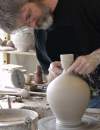 granular
surface as it's stretched by the pressure of my
fingertips. My fascination with texture and the pliable
nature of clay leads me to examine not just the outside,
or on the skin, but inside, below the surface. I challenge
myself by finding new ways to better express and use these
elements in my work. I find the historical uses of clay,
wood, metal, and stone valuable resources, but nothing
speaks to me more clearly than the material itself and how
it responds to manipulation.
granular
surface as it's stretched by the pressure of my
fingertips. My fascination with texture and the pliable
nature of clay leads me to examine not just the outside,
or on the skin, but inside, below the surface. I challenge
myself by finding new ways to better express and use these
elements in my work. I find the historical uses of clay,
wood, metal, and stone valuable resources, but nothing
speaks to me more clearly than the material itself and how
it responds to manipulation.
The
firing process has become as elemental in my work as the
forms and textures I  use. The
controlled chaos of the woodfiring process enhances the
surfaces of my pottery in a way that I cannot do in the
glazing process alone. Imagining how flame and ash will
leave their mark on my work, caressing the textures as
they wrap around the forms, affects the way I think of my
work in the studio.
use. The
controlled chaos of the woodfiring process enhances the
surfaces of my pottery in a way that I cannot do in the
glazing process alone. Imagining how flame and ash will
leave their mark on my work, caressing the textures as
they wrap around the forms, affects the way I think of my
work in the studio.
I have been addicted to clay ever since that first whiff
of the intoxicating aroma of a fresh bag of clay in my
High school art class. It was then that I discovered my
fondness for the yielding nature of clay, that invites my
every touch. I try to approach clay with that same lust
for discovery each time I start to work.
I grew
up close to a traditional folk pottery community but found
that clay has much more to offer than a basic functional
use. Most of the first pieces I made with clay were
abstract and surrealistically sculptural.
Hand building processes offer the
opportunity to feel the suppleness of clay; that sensual
sensation that drew me away from painting. I have
found ways to incorporate handbuilding techniques into my
wheel work, and I spend as much time as I can just
manipulating clay with my fingers.
I have dedicated myself to
the growth of my creative skills and to traveling deeper  into the art of clay and the
creation of interesting pottery forms.
into the art of clay and the
creation of interesting pottery forms.
I have also found satisfaction in my need to share the
knowledge
I have absorbed from my experiences and have been
conducting classes at my studio and offering workshops and
demonstrations for others. Through demonstrations and the
challenge of teaching pottery, I relearn how I make
pottery, and why I am fascinated with every aspect of
working with clay.
I am a juried member of the
League of New Hampshire Craftsmen, and active member of
the Seagrove Area Potters Association, and I am the Past
President of the New Hampshire Potters Guild. I've recently joined the Carolina clay matters
potters guild, and renewed my membership to the Potters
Council.
I’ve been working with clay
since my high school art teacher introduced me to pottery
in 1976. I had been inspired and intrigued by the
terra-cotta figure sculptures my sister had created when
she was taking classes from the same teacher. You
could say I was raised on clay, since I come from the clay
rich soil of North Carolina.
I started my professional
career as a potter in 1981, making piggy banks in a
Wilmington, NC pottery. After spending the next 7
years working for various studio and production potters
along the North Carolina coast and in Seagrove (North
Carolina’s pottery Mecca) I decided to take a job at a New
Hampshire-based salt-glaze pottery factory.
I enjoyed working for this
company because it made me feel like an important and
extremely productive part of something bigger than myself
.
For 10 years I threw
production, designed new items, and helped new potters
learn shapes for this line of turn-of-the-century
reproduction stoneware.
Salmon Falls Stoneware was a large pottery
factory that made traditional style slip trailed saltglaze
pottery, in the style of Norton Pottery, and other
traditional New England, and Hudson River salt glazed
pottery makers of the 1800's...there's that connection to
traditional pottery again...
Occasionally working on
design ideas of my own bizarre imagination, I slowly
became unhinged enough to start thinking seriously about
doing craft shows. After spending 17 years working for
other potters, I felt a strong urge to release the
creativity I had bottled up inside myself.
So, I set up a studio in my
basement, made a bunch of nothing-too-fancy mugs, bowls,
vases, piggy banks, and started hitting the local street
shows.
This is a very tough way to
make money, but a lot of people do a good job at it.
...I still kept my job at the
factory.
Within a year I felt
confident enough to even start entering my work into
juried art exhibitions. After being accepted into a
couple of shows, I realized I should
(and wanted to) focus on
making the most creative work I can make for myself, since
I was doing production back at the factory.
Creating, after all, is my favorite part of making pottery
.
Even though I was able to
make progress with my creative endeavors, a dark dank
cellar was not the most inspirational environment to work
in.
When the opportunity to open
my own studio and retail shop came along, I gradually
moved out of my basement studio and started working out of
the storefront studio that I’m in now.
With the help of several very
good friends I have been able to dedicate myself to the
growth of my creative skills and to traveling deeper into
the art of pottery. I have also found
satisfaction in sharing the knowledge I have absorbed from
my experiences and have been conducting classes at my
studio and offering workshops and demonstrations for
others.
My studio at Northwood
Pottery was housed in an eighteenth century New England
barn. Northwood Pottery has existed, in one form or
another, since 1972, when Jeff Lalish & George Niles
converted the old 1794 barn into a pottery studio.
The barn had previously been Northwood Garage, where
Lalish’s grandfather had run a gas station and Model T
repair from the 1920's on.
This studio was a much more
comfortable place to work in than the Dover basement, with
plenty of room for my imagination to stretch its legs.
After several years of making pots at the
Northwood Pottery location, and driving a half hour from
Dover where I lived at the time, I was able to find a home
and studio location in Northwood.
My studio from 2003 - 2008
was housed in a nineteenth century New England
barn. It is located only 4 miles west of my
previous studio. This location gave even more room
for my thoughts and imagination to run wild. I also
lived a close 30 second walk from home to the studio and
gallery, so I could spend much more time with the clay.
Today... I share my Seagrove, North
Carolina pottery studio and gallery with Michele
Hastings.
We spend our days making pots together and
market or creations in our gallery on Pottery
Highway 705, and online.
 |
Jeff Brown
Pottery
|
505 E Main St
Seagrove, NC 27341
336-873-1001
jeff@jeffbrownpottery.com
Directions